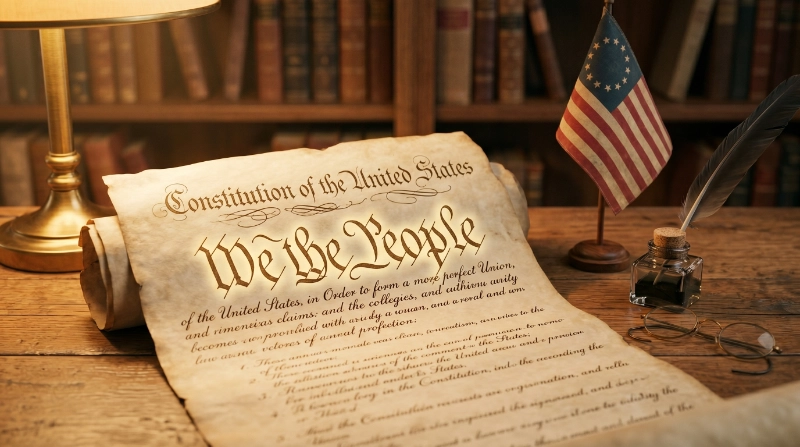
The U.S. Constitution is the supreme law of the land, written in 1787 and ratified in 1788. It sets up the U.S. government, defines how it works, and protects the basic rights of Americans. The citizenship test asks several questions about it, including its purpose, the meaning of "We the People," and the number of amendments.
Key facts to memorize:
- Written in 1787 at the Constitutional Convention in Philadelphia
- Ratified and effective in 1788
- Has 27 amendments (first 10 are the Bill of Rights)
- Begins with "We the People" — establishes government power comes from citizens
- Three main purposes: sets up the government, defines it, and protects rights
What Is the Constitution?
The Constitution is the supreme law of the land. That means no other law — federal, state, or local — can override it. If a law conflicts with the Constitution, that law is invalid.
It was written in 1787 at the Constitutional Convention in Philadelphia. The men who wrote it are called the Founding Fathers or Framers. Notable figures include James Madison (often called the "Father of the Constitution"), George Washington (who presided over the convention), and Benjamin Franklin.
The Constitution went into effect in 1788 after being ratified by the required number of states.
What Does the Constitution Do?
The Constitution serves three main purposes:
-
Sets up the government. It creates three branches — legislative (Congress), executive (the President), and judicial (the courts) — and defines their powers.
-
Defines the government. It establishes how leaders are elected, how laws are made, and how power is divided between the federal government and the states.
-
Protects basic rights of Americans. Through the Bill of Rights and subsequent amendments, it guarantees freedoms like speech, religion, and the right to a fair trial.
The Preamble
The Constitution begins with the Preamble, which starts with the famous words: "We the People." This phrase establishes that the government's power comes from the people — not from a king, not from the military, but from ordinary citizens.
The Preamble is not a law itself. It is a statement of purpose. It explains why the Constitution was written: to form a more perfect union, establish justice, ensure domestic tranquility, provide for the common defense, promote the general welfare, and secure the blessings of liberty.
Amendments: How the Constitution Changes
The Founders knew that the country would change over time, so they built in a process for updating the Constitution. Changes are called amendments.
There are currently 27 amendments to the Constitution.
The first 10 amendments are called the Bill of Rights. They were added in 1791 and guarantee fundamental freedoms like:
- First Amendment — freedom of speech, religion, press, assembly, and petition
- Second Amendment — the right to bear arms
- Fourth Amendment — protection against unreasonable searches
- Fifth Amendment — the right to due process and protection against self-incrimination
Later amendments addressed critical issues:
- 13th Amendment (1865) — abolished slavery
- 15th Amendment (1870) — gave all men the right to vote regardless of race
- 19th Amendment (1920) — gave women the right to vote
- 26th Amendment (1971) — lowered the voting age to 18
The Supremacy Clause
Article VI of the Constitution contains the Supremacy Clause, which states that the Constitution and federal laws made under it are the "supreme law of the land." This means:
- If a state law conflicts with a federal law, the federal law wins
- If any law conflicts with the Constitution itself, the Constitution wins
- The Supreme Court has the power to strike down unconstitutional laws
This principle keeps the entire legal system consistent and prevents individual states from ignoring national standards.
Self-Government and the Rule of Law
Two key ideas run through the entire Constitution:
Self-government — the people govern themselves through elected representatives. The Constitution starts with "We the People" because the government exists to serve the citizens, not the other way around.
Rule of law — everyone, including the President and government officials, must follow the law. No one is above the Constitution.
Test Questions About the Constitution
Here are real citizenship test questions about the Constitution:
Q: What is the supreme law of the land? A: The Constitution
Q: What does the Constitution do? A: Sets up the government / defines the government / protects basic rights of Americans
Q: The idea of self-government is in the first three words of the Constitution. What are these words? A: We the People
Q: How many amendments does the Constitution have? A: 27
Q: What do we call the first ten amendments to the Constitution? A: The Bill of Rights
Frequently Asked Questions
What is the supreme law of the land?
The Constitution. No federal, state, or local law can override it. If a law conflicts with the Constitution, that law is invalid.
What does the Constitution do?
It sets up the U.S. government, defines how the government works, and protects the basic rights of Americans through amendments like the Bill of Rights.
How many amendments does the Constitution have?
The Constitution has 27 amendments. The first 10 are called the Bill of Rights and were added in 1791.
Who wrote the Constitution?
The Constitution was written by 55 delegates at the Constitutional Convention in 1787. James Madison is often called the "Father of the Constitution," and George Washington presided over the convention.
What does "We the People" mean?
The first three words of the Constitution establish that government power comes from the citizens, not from a king or military. This is the foundation of self-government in the United States.
Why is the Constitution still important today?
It remains the supreme law of the land more than 230 years after it was written. Every federal law, state law, and Supreme Court decision must be consistent with it.
Key Takeaways
- The Constitution is the supreme law of the land — no law can override it
- Written in 1787 by the Founding Fathers in Philadelphia
- It sets up the government, defines how it works, and protects basic rights
- There are 27 amendments — the first 10 are the Bill of Rights
- "We the People" — the government gets its power from the people
- The Supremacy Clause means federal law overrides state law when they conflict