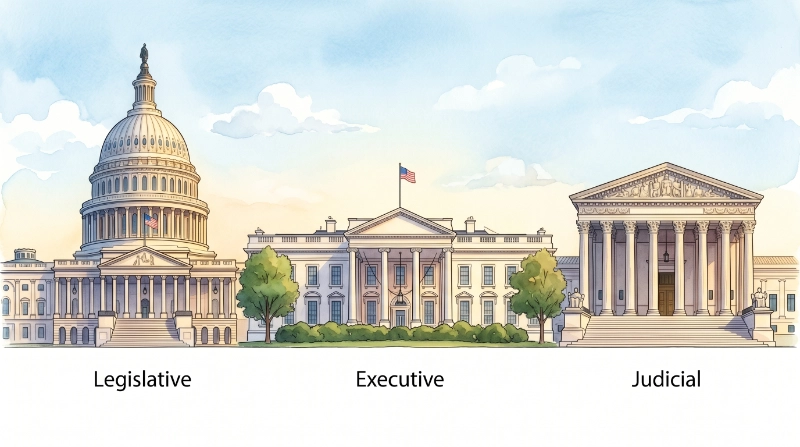
The U.S. government has three branches: the legislative branch (Congress) makes the laws, the executive branch (the President) enforces the laws, and the judicial branch (the courts) interprets the laws. This separation of powers prevents any one branch from becoming too powerful — a system called checks and balances.
Key facts:
- 3 branches: legislative, executive, judicial
- Legislative = Congress (Senate + House of Representatives) — makes laws
- Executive = President + Vice President + Cabinet — enforces laws
- Judicial = Supreme Court + federal courts — interprets laws
- Each branch can check the others to prevent abuse of power
The Three Branches
1. Legislative Branch — Makes the Laws
The legislative branch is Congress, which is divided into two parts:
- The Senate — 100 members, 2 from each state, serving 6-year terms
- The House of Representatives — 435 voting members, based on each state's population, serving 2-year terms
Congress makes federal laws. A bill must pass both the Senate and the House before it goes to the President to be signed into law.
Other powers of Congress:
- Declares war
- Controls the federal budget
- Approves treaties (Senate)
- Confirms presidential appointments (Senate)
- Can impeach the President (House starts, Senate holds the trial)
The current leader of the Senate is the Vice President, who serves as President of the Senate. The day-to-day leader is the Senate Majority Leader. The leader of the House is the Speaker of the House.
2. Executive Branch — Enforces the Laws
The executive branch is led by the President, who is both the head of state and the Commander in Chief of the military. The President serves a 4-year term and can serve a maximum of two terms.
The executive branch includes:
- The Vice President — next in line if the President cannot serve
- The Cabinet — advisors who lead government departments (State, Defense, Treasury, etc.)
- Federal agencies (FBI, CIA, EPA, etc.)
Key powers of the President:
- Signs or vetoes bills from Congress
- Nominates Supreme Court justices and federal judges
- Negotiates treaties with other countries
- Issues executive orders
- Serves as Commander in Chief of the military
The President lives and works at the White House in Washington, D.C.
3. Judicial Branch — Interprets the Laws
The judicial branch is the court system, headed by the Supreme Court. Its job is to interpret laws and decide whether they follow the Constitution.
The Supreme Court has 9 justices, including the Chief Justice. They are nominated by the President, confirmed by the Senate, and serve for life (there is no fixed term).
Key powers:
- Reviews laws to determine if they are constitutional
- Settles disputes between states
- Has the final say on legal questions
The power to declare a law unconstitutional is called judicial review. It was established in the landmark case Marbury v. Madison (1803).
Checks and Balances
The three branches do not operate in isolation. They check each other's power:
- Congress can override a presidential veto with a two-thirds vote
- The President can veto bills passed by Congress
- The Supreme Court can strike down laws passed by Congress or actions taken by the President
- The Senate must confirm the President's Supreme Court nominees
- Congress can impeach and remove the President or federal judges
This system ensures that no branch becomes too powerful. It is one of the most tested concepts on the citizenship test.
Why Three Branches?
The Founders had experienced life under a king who held absolute power. They designed the government so that power was spread out and each branch could hold the others accountable.
As James Madison wrote in the Federalist Papers: "If men were angels, no government would be necessary." Because people are not perfect, the system of checks and balances keeps everyone in line — including the government itself.
Test Questions About the Branches
Q: Name one branch or part of the government. A: Congress / legislative, President / executive, the courts / judicial
Q: What stops one branch of government from becoming too powerful? A: Checks and balances / separation of powers
Q: Who makes federal laws? A: Congress / Senate and House / U.S. legislature
Q: What does the judicial branch do? A: Reviews laws / explains laws / resolves disputes / decides if a law goes against the Constitution
Q: Who is the Commander in Chief of the military? A: The President
Q: How many justices are on the Supreme Court? A: 9
Frequently Asked Questions
What are the three branches of government?
The three branches are the legislative branch (Congress), the executive branch (the President), and the judicial branch (the courts). Each branch has separate powers and responsibilities.
What does each branch of government do?
The legislative branch makes laws, the executive branch enforces laws, and the judicial branch interprets laws and decides if they follow the Constitution.
Why do we have three branches of government?
The Founders created three branches to prevent any single person or group from gaining too much power. This is called the separation of powers.
What are checks and balances?
Checks and balances is a system where each branch of government can limit the power of the other two branches. For example, the President can veto laws, Congress can override vetoes, and the Supreme Court can strike down unconstitutional laws.
Who is the head of the executive branch?
The President of the United States is the head of the executive branch and serves as Commander in Chief of the military.
Which branch is the most powerful?
No single branch is more powerful than the others by design. The system of checks and balances keeps all three branches roughly equal in power.
What are 3 facts about the three branches of government?
Three core facts: (1) The three branches are the legislative branch (Congress, which makes laws), the executive branch (the President, who enforces laws), and the judicial branch (the courts, which interpret laws). (2) The three branches are designed to check and balance each other so no single branch can become too powerful — for example, Congress passes laws, the President can veto them, and the Supreme Court can rule them unconstitutional. (3) The three-branch structure comes directly from the U.S. Constitution, specifically Articles I (Legislative), II (Executive), and III (Judicial).
Who heads each branch of government?
The President heads the executive branch and is also called the Commander in Chief of the military. The Speaker of the House and the Vice President (as President of the Senate) lead the two chambers of the legislative branch — Congress. The Chief Justice of the United States heads the judicial branch and leads the U.S. Supreme Court. On the USCIS civics test, the accepted answer to "Who is in charge of the executive branch?" is the President.
How are members of each branch chosen?
Members of the three branches are chosen in three different ways. Legislative branch: voters elect senators (statewide) and representatives (per congressional district) directly. Executive branch: voters elect the President and Vice President every 4 years through the Electoral College. Judicial branch: the President nominates federal judges and Supreme Court justices, and the Senate confirms them — these positions are not elected. Federal judges and Supreme Court justices serve lifetime appointments, which is a frequent USCIS civics test fact.
What is the legislative branch responsible for?
The legislative branch — Congress, made up of the Senate and the House of Representatives — is responsible for making federal laws, declaring war, approving the federal budget, raising taxes, regulating interstate and foreign trade, and confirming presidential nominations. On the USCIS civics test, the accepted answer to "Who makes federal laws?" is Congress (Senate and House of Representatives) or the (U.S. or national) legislature.
Key Takeaways
- Three branches: Legislative (Congress), Executive (President), Judicial (Courts)
- Congress makes laws, the President enforces them, the courts interpret them
- Checks and balances prevent any branch from becoming too powerful
- Congress has 535 voting members (100 senators + 435 representatives)
- The President serves a 4-year term, max 2 terms
- The Supreme Court has 9 justices who serve for life
- This system was designed to prevent the concentration of power