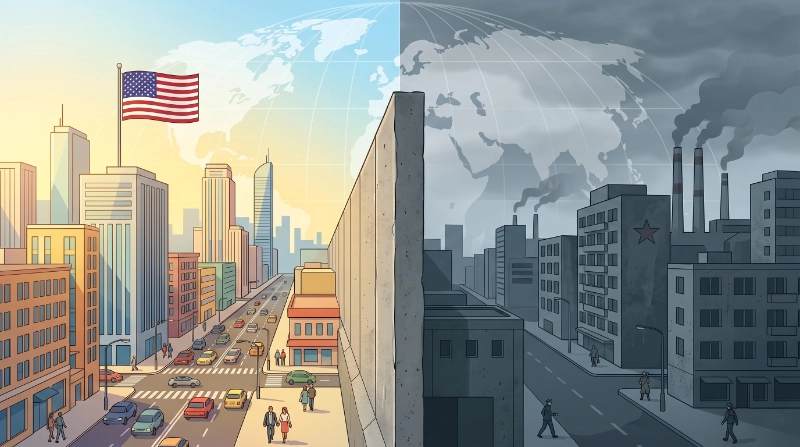
The Cold War (1947-1991) was a 44-year geopolitical struggle between the United States and the Soviet Union following World War II. Though no direct military conflict occurred between the superpowers, they competed through proxy wars, the arms race, and the Space Race. The Cold War ended with the dissolution of the Soviet Union in 1991.
Key facts:
- Lasted from approximately 1947 to 1991 (44 years)
- United States (capitalism, democracy) vs. Soviet Union (communism)
- Major conflicts: Korean War (1950-1953) and Vietnam War (1955-1975)
- Cuban Missile Crisis (1962) — closest the world came to nuclear war
- Berlin Wall built in 1961, fell in 1989
- The Soviet Union dissolved in December 1991
What Was the Cold War About?
At its core, the Cold War was a conflict between two opposing systems:
- The United States — democracy, capitalism, individual freedom
- The Soviet Union — communism, state-controlled economy, one-party government
Each side believed its system was better and worked to spread its influence around the world. The citizenship test asks:
"During the Cold War, what was the main concern of the United States?" Answer: Communism
The U.S. feared that communism would spread to other countries, threatening democracy and free markets worldwide. This fear drove American foreign policy for over 40 years.
Key Events of the Cold War
The Iron Curtain (1946)
After WWII, the Soviet Union took control of Eastern Europe — Poland, East Germany, Czechoslovakia, Hungary, Romania, and others. British Prime Minister Winston Churchill described this division as an "Iron Curtain" falling across Europe.
The Berlin Wall (1961-1989)
Germany was divided into West Germany (democratic, allied with the U.S.) and East Germany (communist, allied with the Soviet Union). The capital city, Berlin, was also divided. In 1961, East Germany built a wall through Berlin to prevent people from fleeing to the West.
The Berlin Wall became the most visible symbol of the Cold War. It stood for 28 years until it fell on November 9, 1989.
The Korean War (1950-1953)
Communist North Korea invaded South Korea. The United States and United Nations forces fought to defend South Korea. The war ended in a stalemate — Korea remains divided today at the 38th parallel.
The Cuban Missile Crisis (1962)
The Soviet Union placed nuclear missiles in Cuba, just 90 miles from Florida. For 13 days, the world stood on the brink of nuclear war. President John F. Kennedy negotiated with Soviet leader Nikita Khrushchev, and the Soviets agreed to remove the missiles. It was the closest the Cold War came to becoming a hot war.
The Vietnam War (1955-1975)
The U.S. fought to prevent communist North Vietnam from taking over South Vietnam. It became deeply unpopular at home. Over 58,000 Americans died. The U.S. withdrew in 1973, and Vietnam was unified under communist rule in 1975.
The Space Race
The U.S. and Soviet Union competed to achieve firsts in space exploration:
- 1957 — Soviet Union launched Sputnik, the first satellite
- 1961 — Soviet cosmonaut Yuri Gagarin became the first human in space
- 1969 — American astronaut Neil Armstrong became the first person to walk on the moon
The Space Race was about national prestige and technological superiority.
The Arms Race
Both nations built thousands of nuclear weapons. The doctrine of Mutual Assured Destruction (MAD) meant that if either side launched a nuclear attack, both would be destroyed. This terrifying logic actually prevented direct conflict.
How Did the Cold War End?
By the late 1980s, the Soviet Union was weakening economically and politically. Soviet leader Mikhail Gorbachev introduced reforms (glasnost and perestroika) that opened up Soviet society.
Key moments:
- 1989 — The Berlin Wall fell, symbolizing the end of communist control in Eastern Europe
- 1989-1991 — Eastern European countries held free elections and left Soviet control
- 1991 — The Soviet Union dissolved into 15 independent countries, including Russia
The Cold War was over. The United States remained the world's sole superpower.
Presidents During the Cold War
| President | Years | Key Cold War Action | |---|---|
Continue Learning
Frequently Asked Questions
What was the Cold War?
The Cold War was a geopolitical and ideological struggle between the United States and the Soviet Union from 1947 to 1991. It was called "cold" because the two superpowers never fought each other directly with military force.
What was the United States' main concern during the Cold War?
The main concern was the spread of communism. The U.S. worked to contain Soviet influence around the world through alliances, foreign aid, and military intervention in countries like Korea and Vietnam.
Who were the main parties in the Cold War?
The two main parties were the United States (leading the capitalist, democratic Western Bloc) and the Soviet Union (leading the communist Eastern Bloc). NATO and the Warsaw Pact were the main military alliances.
When did the Cold War end?
The Cold War effectively ended in 1989 with the fall of the Berlin Wall and ended officially in December 1991 when the Soviet Union dissolved. The U.S. emerged as the world's sole superpower.
What was the Cuban Missile Crisis?
The Cuban Missile Crisis (October 1962) was a 13-day standoff between the U.S. and Soviet Union after the Soviets placed nuclear missiles in Cuba. It is considered the closest the world has ever come to nuclear war.
What conflicts happened during the Cold War?
The Korean War (1950-1953), Vietnam War (1955-1975), and Soviet-Afghan War (1979-1989) were major proxy conflicts during the Cold War, where the U.S. and Soviet Union supported opposing sides.