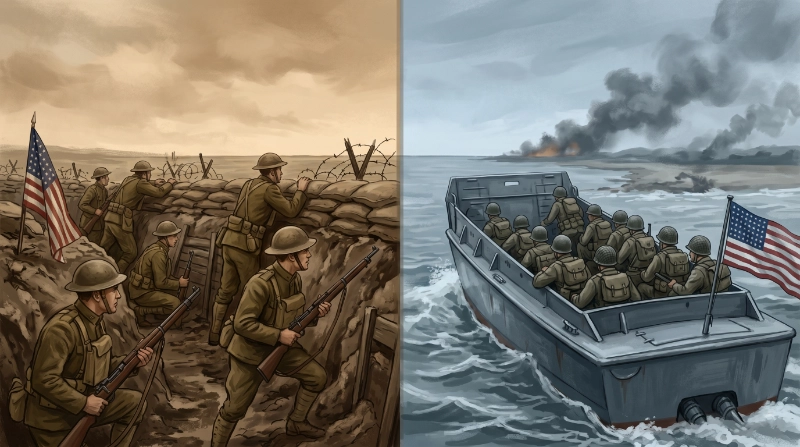
The United States fought in both World Wars of the 20th century. World War I (1914-1918) ended with America joining the Allies in 1917 and helping defeat Germany. World War II (1939-1945) saw the U.S. enter after the Japanese attack on Pearl Harbor on December 7, 1941, and end with the defeat of Germany and Japan in 1945.
Key facts:
- WWI: 1914-1918, U.S. joined in 1917 under President Woodrow Wilson
- WWII: 1939-1945, U.S. joined after Pearl Harbor attack on December 7, 1941
- WWII presidents: Franklin D. Roosevelt (most of the war) and Harry Truman (final months)
- Allies (US, UK, France, USSR) defeated Axis (Germany, Italy, Japan)
- WWII ended in Europe (May 1945) and Pacific (August 1945, after atomic bombs)
- WWII established the U.S. as a global superpower
World War I (1914-1918)
What Started It?
World War I began in Europe in 1914, sparked by the assassination of Archduke Franz Ferdinand of Austria-Hungary. A web of alliances pulled most of Europe into the conflict.
The two sides:
- Allied Powers: Britain, France, Russia (later joined by the U.S.)
- Central Powers: Germany, Austria-Hungary, Ottoman Empire
Why Did the U.S. Enter?
The United States initially stayed neutral. President Woodrow Wilson won re-election in 1916 with the slogan "He kept us out of war." But two events changed that:
- Unrestricted submarine warfare — Germany sank civilian and merchant ships, including the Lusitania (1915), killing 1,198 people including 128 Americans
- The Zimmermann Telegram (1917) — Germany secretly proposed a military alliance with Mexico against the United States
The U.S. entered the war in April 1917.
The Outcome
American troops and resources helped turn the tide. Germany surrendered on November 11, 1918 — now celebrated as Veterans Day.
After the war, President Wilson proposed the League of Nations — an international organization to prevent future wars. Ironically, the U.S. Senate rejected membership.
World War II (1939-1945)
What Started It?
World War II began when Nazi Germany, led by Adolf Hitler, invaded Poland in September 1939. Hitler's goals included expanding German territory and implementing racist ideology that led to the Holocaust — the systematic murder of 6 million Jews and millions of others.
The two sides:
- Allied Powers: United States, Britain, France, Soviet Union, China
- Axis Powers: Germany, Italy, Japan
Why Did the U.S. Enter?
Again, the U.S. initially remained neutral. That changed on December 7, 1941, when Japan attacked Pearl Harbor — a U.S. naval base in Hawaii. The surprise attack killed over 2,400 Americans.
The next day, President Franklin D. Roosevelt asked Congress to declare war, calling December 7 "a date which will live in infamy."
Key Events
- D-Day (June 6, 1944) — Allied forces invaded Normandy, France, beginning the liberation of Western Europe
- Battle of Midway (1942) — turning point in the Pacific war against Japan
- V-E Day (May 8, 1945) — Victory in Europe; Germany surrendered
- Atomic bombs (August 1945) — the U.S. dropped atomic bombs on Hiroshima and Nagasaki, Japan
- V-J Day (August 15, 1945) — Japan surrendered, ending the war
The Outcome
World War II resulted in:
- Over 60 million deaths worldwide
- The creation of the United Nations (1945) to prevent future global conflicts
- The United States and Soviet Union emerging as the world's two superpowers
- The beginning of the Cold War
Key Presidents During the Wars
| War | President | Key Action | |---|---|
Continue Learning
Frequently Asked Questions
When did the United States enter World War I?
The U.S. entered World War I in April 1917 under President Woodrow Wilson, after Germany resumed unrestricted submarine warfare against American shipping.
What event caused the U.S. to enter World War II?
Japan's attack on the U.S. naval base at Pearl Harbor, Hawaii, on December 7, 1941, brought the United States into World War II. President Franklin D. Roosevelt called it "a date which will live in infamy."
Who was President during World War II?
Franklin D. Roosevelt was President for most of World War II. After his death in April 1945, Vice President Harry Truman became President and led the country through the final months of the war.
Who fought in World War II?
The Allied Powers (United States, United Kingdom, Soviet Union, France, China) fought against the Axis Powers (Germany, Italy, Japan). The Allies won.
What ended World War II in the Pacific?
The U.S. dropped atomic bombs on Hiroshima (August 6, 1945) and Nagasaki (August 9, 1945). Japan surrendered on August 15, 1945, ending World War II.
What was the impact of World War II on America?
World War II ended the Great Depression, established the U.S. as a global superpower, started the atomic age, and led to the Cold War with the Soviet Union. It also expanded civil rights movements at home.
What was America's role in World War I?
America entered World War I in April 1917, three years after the war began in Europe. The U.S. joined the Allied Powers (United Kingdom, France, Italy, Russia, and Japan) against the Central Powers (Germany, Austria-Hungary, and the Ottoman Empire). American fresh troops and industrial supplies tipped the balance, and President Woodrow Wilson's "Fourteen Points" shaped the postwar peace at the Treaty of Versailles. On the USCIS civics test, the accepted answer to "Who was President during World War I?" is (Woodrow) Wilson.
What was America's role in World War II?
America entered World War II in December 1941 after the Japanese attack on Pearl Harbor on December 7. The U.S. fought as one of the Allies (with the United Kingdom, Soviet Union, France, and China) against the Axis Powers (Germany, Italy, and Japan). American industrial output, troop deployments in both Europe and the Pacific, and the development of the atomic bomb were decisive. On the USCIS civics test, accepted answers to "Who was President during World War II?" include (Franklin) Roosevelt and (Dwight) Eisenhower.
Who were America's allies in World War I and World War II?
In World War I, America's main allies were the United Kingdom, France, Italy, Russia, and Japan — together called the Allied Powers, fighting against Germany, Austria-Hungary, and the Ottoman Empire. In World War II, America's main allies were the United Kingdom, Soviet Union, France, and China — fighting against the Axis Powers: Germany, Italy, and Japan. On the USCIS civics test, the accepted answer to "Who did the United States fight in World War II?" is Japan, Germany, and Italy.
Why are WWI and WWII on the U.S. citizenship test?
World War I and World War II are on the U.S. citizenship test because they shaped how the modern United States works — its role as a global power, its military and diplomatic structure, and many of its civil rights laws. The USCIS officer may ask "Name one war fought by the United States in the 1900s" (accepted answers: World War I, World War II, Korean War, Vietnam War, Persian Gulf War), "Who was President during World War I?" (Wilson), or "Who was President during World War II?" (Roosevelt or Eisenhower). You can practice these questions in our free 10-question demo or browse all study tools.