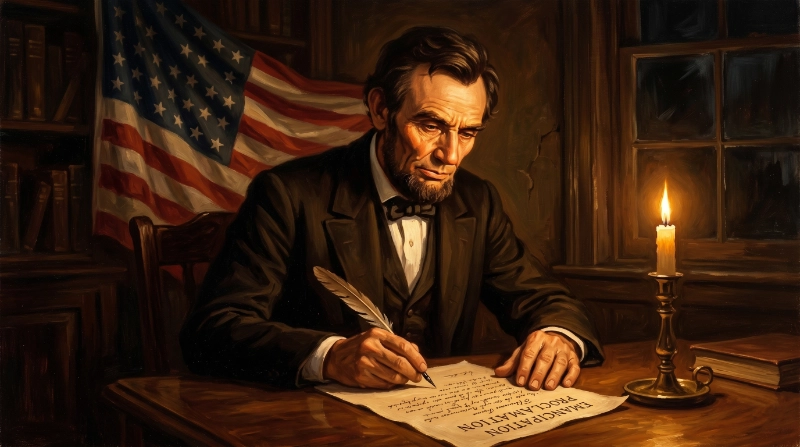
Abraham Lincoln was the 16th President of the United States (1861-1865) and led the country through the Civil War. He issued the Emancipation Proclamation on January 1, 1863, declaring that all slaves in Confederate states were free. Lincoln was assassinated in April 1865, just days after the Civil War ended.
Key facts:
- 16th President, served 1861 until his assassination in 1865
- Led the Union through the Civil War
- Issued the Emancipation Proclamation on January 1, 1863
- Delivered the Gettysburg Address in November 1863
- Assassinated by John Wilkes Booth at Ford's Theatre, April 14, 1865
- His face appears on the penny and the $5 bill
Who Was Abraham Lincoln?
- 16th President of the United States (1861-1865)
- Born in a log cabin in Kentucky in 1809
- Self-educated — taught himself law by reading books
- Elected President in 1860 on an anti-slavery expansion platform
- Led the Union during the Civil War
- Assassinated by John Wilkes Booth on April 14, 1865
Lincoln is remembered for three things the citizenship test asks about:
- Freed the slaves (Emancipation Proclamation)
- Saved (preserved) the Union
- Led the United States during the Civil War
The Emancipation Proclamation
On January 1, 1863, Lincoln issued the Emancipation Proclamation. It declared that all enslaved people in the Confederate states "shall be then, thenceforward, and forever free."
What It Did
- Freed slaves in Confederate states — the states that were in rebellion against the Union
- Transformed the purpose of the war — it was no longer just about preserving the Union, but about ending slavery
- Allowed African Americans to join the military — approximately 180,000 Black soldiers served in the Union Army by the war's end
- Sent a moral message to the world that America stood for freedom
What It Did Not Do
- It did not free slaves in border states (like Kentucky and Maryland) that remained in the Union
- It could not be immediately enforced in Confederate territory — Union troops had to win battles to liberate enslaved people
- It was a wartime measure, not a constitutional amendment
That is why the 13th Amendment (1865) was necessary — it permanently abolished slavery throughout the entire United States.
Lincoln's Leadership
Lincoln faced an impossible situation. When he took office, the country was splitting apart. Seven states had already seceded before his inauguration. He had to decide: let the country break in two, or fight to hold it together.
He chose to fight — not because he wanted war, but because he believed the Union was worth preserving. As he said in the Gettysburg Address: the war was being fought so "that government of the people, by the people, for the people, shall not perish from the earth."
Key Decisions
- Called for 75,000 volunteers after Fort Sumter was attacked
- Appointed Ulysses S. Grant as commanding general, who eventually won the war
- Signed the Homestead Act — gave free land to settlers willing to farm it
- Established Thanksgiving as a national holiday
- Pushed for the 13th Amendment — worked to get it through Congress before the war ended
The Gettysburg Address
In November 1863, Lincoln delivered a short speech at the site of the Battle of Gettysburg in Pennsylvania, where over 50,000 soldiers had been killed or wounded. The speech lasted about two minutes but became one of the most important speeches in American history.
Key ideas:
- The nation was founded on the principle that "all men are created equal"
- The soldiers who died gave their lives so the nation could survive
- It is the duty of the living to continue the work of preserving democracy
Lincoln's Assassination
On April 14, 1865 — just five days after the Confederate surrender — Lincoln was shot by John Wilkes Booth while attending a play at Ford's Theatre in Washington, D.C. He died the next morning.
His death shocked the nation. Lincoln did not live to see the full results of his work — the 13th Amendment was ratified in December 1865, eight months after his assassination.
Test Questions About Lincoln
Q: What was one important thing that Abraham Lincoln did? A: Freed the slaves (Emancipation Proclamation) / saved (preserved) the Union / led the United States during the Civil War
Q: What did the Emancipation Proclamation do? A: Freed the slaves / freed slaves in the Confederacy / freed slaves in Confederate states / freed slaves in most Southern states
Q: Who was President during the Civil War? A: Abraham Lincoln
Q: What did the 13th Amendment do? A: Abolished slavery / banned slavery
Frequently Asked Questions
Who was Abraham Lincoln?
Abraham Lincoln was the 16th President of the United States (1861-1865). He led the country through the Civil War, issued the Emancipation Proclamation freeing slaves in Confederate states, and was assassinated shortly after the war ended.
What did the Emancipation Proclamation do?
The Emancipation Proclamation, issued on January 1, 1863, declared that all slaves in Confederate states were free. It changed the war's purpose to include ending slavery and laid the groundwork for the 13th Amendment.
What did Lincoln do as President?
Lincoln preserved the Union during the Civil War, freed the slaves through the Emancipation Proclamation, gave the Gettysburg Address, and signed the Homestead Act and Morrill Land Grant Act.
Why is Lincoln considered a great President?
Lincoln is considered great for keeping the United States united during its most divisive crisis, ending slavery, and articulating the principles of democracy in speeches like the Gettysburg Address.
Where can I see Abraham Lincoln's face today?
Lincoln's face appears on the U.S. penny and the $5 bill. The Lincoln Memorial in Washington, D.C., features a 19-foot statue of him reading the Gettysburg Address.
When did Lincoln die?
Abraham Lincoln was assassinated by John Wilkes Booth at Ford's Theatre in Washington, D.C., on April 14, 1865, and died the following morning. His death came just five days after the Civil War effectively ended.
Key Takeaways
- Abraham Lincoln was the 16th President (1861-1865)
- Three key accomplishments: freed the slaves, preserved the Union, led during the Civil War
- The Emancipation Proclamation (1863) freed slaves in Confederate states
- The 13th Amendment (1865) abolished slavery everywhere
- The Gettysburg Address reaffirmed America's commitment to equality and democracy
- Lincoln was assassinated just days after the war ended