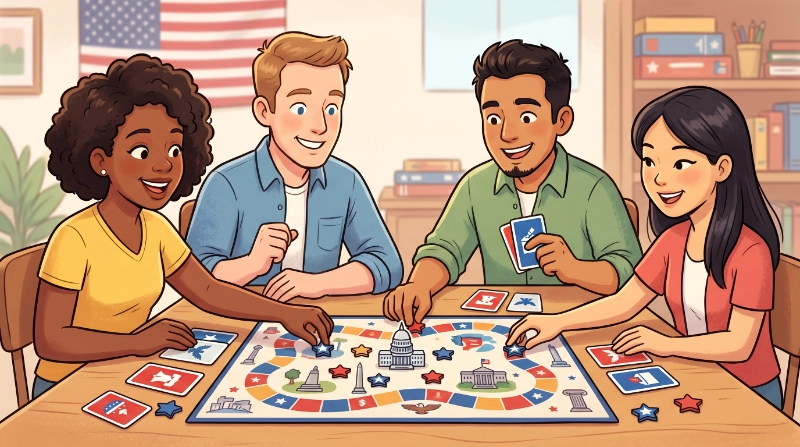
MyCitizenPrep includes 6 free citizenship test games that reinforce the U.S. citizenship test material from different angles — turning study time into play while building stronger long-term memory than flashcards alone.
The 6 games and what each teaches:
- True or False — critical thinking on civics statements
- Speed Round — quick recall under a 10-second timer (matches interview pace)
- Who Am I? — deepens knowledge of presidents and historical figures
- Word Scramble — civics vocabulary recognition (helps the English portion too)
- Word Search — visual term spotting under time pressure
- Name This Place — U.S. geography and landmarks
Why Citizenship Games Beat Flashcards
When you study flashcards or practice questions, you are using one type of memory — declarative memory (remembering facts). When you play a game, you engage additional parts of your brain:
- Pattern recognition — spotting the right answer quickly
- Emotional engagement — the satisfaction of beating a score or solving a puzzle
- Motor memory — tapping, swiping, and physically interacting with the content
- Time pressure — forcing your brain to retrieve answers faster
The result is that information sticks better. You are building multiple pathways to the same knowledge, which makes it easier to recall during your interview.
The Six Games — and What Each One Teaches
True or False
How it works: You see a statement about American government, history, or civics. Decide if it is true or false. No timer — take your time and think.
What it teaches: Critical thinking. Some statements are deliberately tricky. "The Declaration of Independence was signed in 1776" is true. But "The Constitution was written in 1776" is false — it was written in 1787. The game trains you to read carefully and evaluate facts, not just recognize them.
Best for: Reviewing after you have already learned the material. It tests understanding, not just memorization.
Speed Round
How it works: 20 questions, 10 seconds each. Answer before time runs out.
What it teaches: Quick recall. During your USCIS interview, you want answers to come naturally without long pauses. Speed Round trains exactly that reflex. At first, 10 seconds feels fast. After a few rounds, you will be answering in 3-4 seconds.
Best for: Warm-up before a Practice Quiz, or building confidence close to your interview date. If you can answer under time pressure, the real test will feel relaxed.
Who Am I?
How it works: You receive clues about a famous American — one at a time. Guess who it is with as few clues as possible.
What it teaches: Historical figures in context. Instead of memorizing "George Washington — first President," you learn that he also led the Continental Army, presided over the Constitutional Convention, and is called the Father of Our Country. The game builds a fuller picture of the people you need to know.
Best for: Learning about presidents, founding fathers, civil rights leaders, and other key figures. It turns dry biography into a guessing game.
Word Scramble
How it works: You see scrambled letters. Unscramble them to form a civics term — like "CONSTITUTION" or "AMENDMENT."
What it teaches: Vocabulary recognition. Many citizenship test questions use specific terms — Congress, amendment, veto, democracy. Word Scramble forces you to engage with these words letter by letter, which helps with both recognition and the English reading/writing portion of the test.
Best for: Building familiarity with civics vocabulary. Especially helpful if English is not your first language.
Word Search
How it works: Find hidden civics words in a grid of letters. Beat the clock.
What it teaches: Term recognition under time pressure. Your eyes learn to spot words like "Senate," "freedom," and "Constitution" quickly. This strengthens your reading speed and familiarity with key terminology.
Best for: A relaxing study break that still keeps your brain engaged with civics terms. Good for visual learners.
Name This Place
How it works: You see a description or image of a famous American place. Guess where it is.
What it teaches: U.S. geography and landmarks. The citizenship test includes questions about rivers, oceans, borders, and states. This game makes geography memorable by connecting it to real places — the Statue of Liberty, the Grand Canyon, the Mississippi River.
Best for: Studying the geography section of the test (questions about rivers, oceans, borders, territories). Turns map knowledge into a game.
Compare the 6 games at a glance
| Game | Best for | Time per round | Skill it builds | Difficulty |
|---|---|---|---|---|
| True or False | First-time studiers | 5–10 min | Critical thinking | Easy |
| Speed Round | Pre-interview warm-up | 3 min | Quick recall under pressure | Medium |
| Who Am I? | Learning historical figures | 5–10 min | Contextual memory | Medium |
| Word Scramble | English vocabulary | 5–10 min | Term recognition | Medium |
| Word Search | Visual learners, study breaks | 5–10 min | Visual term spotting | Easy |
| Name This Place | Geography questions | 5–10 min | U.S. geography recall | Medium |
Use this table to pick a game based on what you want to practice. The first time through, True or False is the easiest entry point. As you get closer to your interview, Speed Round is the most effective for building real-test-pace recall.
The Scoring System
Every game tracks your performance. Play each game at least 3 times to earn a qualified score. Your scores are combined into an Overall Score ranked from 0 to 1,000:
| Score | Title |
|---|---|
| 0-199 | Rookie |
| 200-399 | Explorer |
| 400-599 | Patriot |
| 600-799 | Scholar |
| 800-1000 | Legend |
You can see your title and score on your dashboard. It is a fun way to track progress beyond just "how many questions did I answer correctly."
The Leaderboard
If you want some friendly competition, set a display name and join the leaderboard. See how your Overall Score compares to other users. It is optional — you control whether your name appears or not.
Competition can be a powerful motivator. When you see someone ahead of you, it makes you want to play one more round. And every round is more learning.
How to Fit Games into Your Study Plan
Games are not a replacement for lessons and practice rounds. They are a supplement to your overall study plan that makes the learning process more enjoyable and effective. Here is how to fit them in:
- After a practice round: Play one game to decompress while staying in study mode.
- On rest days: Instead of skipping study entirely, play 2-3 games. You are still learning.
- As a warm-up: Play Speed Round before a Practice Quiz to activate your recall.
- When motivation is low: Some days you do not feel like studying. Playing a game is better than doing nothing. Even 5 minutes of True or False keeps the material fresh.
The Science Behind It
Educational research consistently shows that varied practice is more effective than repetitive drilling. When you learn the same material through different formats — reading, multiple choice, timed recall, puzzles, geography — you create more mental connections to each fact.
This is called interleaving, and it is one of the most effective study techniques known. The games on MyCitizenPrep apply this principle automatically. You do not need to plan it — just study your lessons and play the games, and your brain does the rest.
Frequently Asked Questions
Can I pass the citizenship test by only playing games?
No. Games supplement lessons and practice rounds — they do not replace them. The most effective approach combines lessons (Learn), practice quizzes (Practice), and games (Play).
Which game is best for first-time citizenship test studiers?
True or False is the best starting game. It has no timer, presents civics statements clearly, and teaches you to evaluate facts carefully — a skill the real test rewards.
How do games improve memory for the citizenship test?
Games engage pattern recognition, emotional engagement, motor memory, and time pressure — all in addition to declarative memory. This is called interleaving and creates multiple mental pathways to the same fact.
What is the difference between Speed Round and the Practice Quiz?
Speed Round has a 10-second timer per question to build quick recall. The Practice Quiz has no timer and tests broader civics knowledge across all topics — closer to the real interview pace.
What is the leaderboard?
The leaderboard ranks players by their Overall Score (a triathlon-style combination of all 6 game scores normalized to a 0-1000 scale). Joining is optional — you control your display name and visibility.
Should I play games on study rest days?
Yes. Games are a low-effort way to keep civics material fresh on days when you do not feel like a full study session. Even 5 minutes of True or False prevents memory decay.
Key Takeaways
- 6 games reinforce civics knowledge from different angles
- Games engage pattern recognition, emotion, and time pressure — not just memorization
- Speed Round builds the quick recall you need for the real interview
- Who Am I? deepens your knowledge of historical figures
- Word Scramble and Word Search strengthen civics vocabulary
- Name This Place makes geography memorable
- Play each game 3 times to earn a ranked score
- Use games as warm-ups, study breaks, and rest-day activities