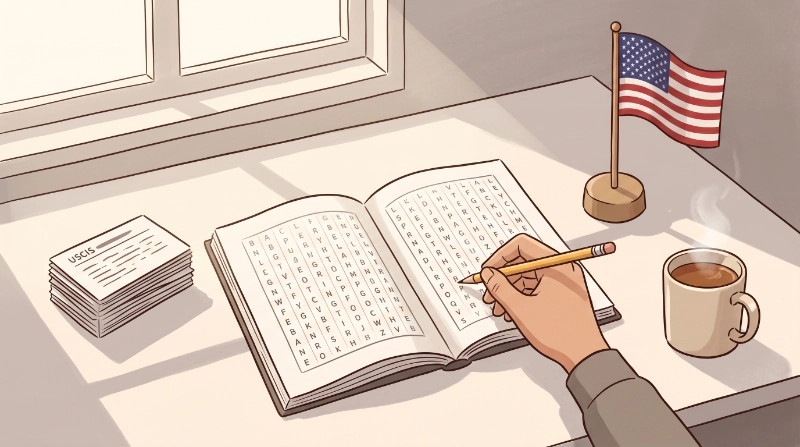
A civics word search is a vocabulary puzzle built around the terms tested on the U.S. citizenship interview — presidents, the three branches of government, founding documents, key amendments, and the people and ideas that shape American civics. Used right, it is a low-pressure way to recognize and retain the words the USCIS officer will use during your naturalization interview.
Key facts:
- 128 official civics questions are tested on the 2025 USCIS naturalization interview (100 on the 2008 test, still active for some applicants).
- 50+ recurring vocabulary terms appear across those civics questions — from "Constitution" to "Commander in Chief."
- 2–5 minutes per round is the typical play time for a focused civics word search puzzle.
- No memorization pressure — word searches build recognition, which is the first step toward recall.
Civics word searches do not replace flashcards or practice quizzes — but they pair well with them as a low-stakes warm-up before harder study.
What is a civics word search?
A civics word search is a grid puzzle where you find U.S. civics vocabulary hidden among random letters — horizontally, vertically, or diagonally. Each word on the puzzle's word list is a term that appears in the official USCIS civics question set. Finding "Senate" three times across different puzzles makes the word stick in a way that staring at a flashcard does not.
The puzzle format works because reading the same civics term in different contexts — a flashcard, a quiz prompt, a word search — builds the cognitive pathway you need when the USCIS officer asks the question aloud. Recognition has to happen before recall.
How a civics word search helps you study for the citizenship test
Most citizenship applicants are studying in a second language, often after a long workday. A civics word search helps in four concrete ways:
- Vocabulary repetition without boredom. Re-reading the same flashcards 20 times triggers fatigue. Spotting "Constitution" inside a fresh grid feels like a small win each time — and the word goes in the same memory bank.
- Recognition before recall. The USCIS interview is oral. Before you can say "Bill of Rights," you have to recognize it when the officer says it. Word searches train recognition specifically.
- Multi-angle exposure to one idea. Flashcards teach a term as a definition. Word searches teach it as a sequence of letters. Quizzes teach it as a claim to verify. Seeing the same fact in three formats helps it stick.
- Low-stakes practice. A missed word in a puzzle costs nothing — so you actually attempt the recognition instead of just re-reading. Trying-and-checking is what builds real memory.
For ESL learners especially, the word-search format also reinforces spelling and letter patterns — useful for the reading and writing portion of the citizenship test, which requires writing one civics-related sentence dictated by the officer.
Vocabulary you will find in a citizenship word search
A well-built civics word search pulls vocabulary from every section of the USCIS civics test. Here are the categories most commonly covered:
Government structure
Congress, Senate, House, President, Vice President, Cabinet, Supreme Court, Governor, Mayor, Legislative, Executive, Judicial, Federal, State.
Founding documents and ideas
Constitution, Declaration, Independence, Amendment, Liberty, Justice, Rights, Republic, Democracy, Citizen, Naturalization, Oath, Allegiance.
Key people
Washington, Lincoln, Jefferson, Madison, Franklin, Roosevelt, Eisenhower, Wilson, King, Anthony.
Civics events and concepts
Revolution, War, Civil, Cold, Slavery, Suffrage, Civil Rights, Pledge, Voting, Election, Census, Capital, Flag, Anthem.
Geographic and symbolic terms
America, United States, Washington (D.C.), Mississippi, Pacific, Atlantic, Eagle, Stars, Stripes.
Each of these terms appears in at least one official USCIS civics question. Finding them inside a puzzle teaches you to recognize them inside the question.
Try the free civics word search now
Our Civics Word Search game gives you a free 5-item preview — no sign-up, plays in your browser. Each puzzle pulls from the categories above, with words ranging from short ("Flag") to long ("Constitution"). The full version unlocks longer puzzles, the complete USCIS vocabulary set, and tracks your time across rounds.
If you prefer a printable civics word search, you can take a screenshot of the free preview puzzle and print it from your browser. The free preview puzzles rotate each session so you can print several different grids.
Civics word search vs other citizenship study tools
A word search is one tool — not the whole study plan. Here is how it compares to the other study methods most applicants use:
| Tool | Best for | Limit |
|---|---|---|
| Civics word search | Vocabulary recognition, low-stakes review, ESL spelling reinforcement | Does not teach the answer to each civics question |
| Flashcards | Direct Q&A memorization | Static format — fatigue sets in quickly |
| Practice quizzes | Rehearsing the actual interview format | Can feel high-stakes when studying alone |
| Audio drills | Hearing how each question sounds before the officer asks | Requires headphones or quiet space |
| Practice tests | Simulating the real 10-question, 6-correct format | Best used once you have already studied the answers |
Most applicants who pass on the first attempt use 2–3 of these tools together. Word searches work best as a 5-minute warm-up before harder study, or as a low-pressure break between quiz rounds.
Tips for using a civics word search as a study aid
A civics word search is most useful when you treat it as part of a larger plan, not the plan itself. A few practical tips:
- Say each word aloud as you find it. The USCIS interview is oral — speaking the term reinforces it for the format you will actually be tested in.
- After finishing a puzzle, write the words by hand on a separate sheet. Hand-writing forces deeper processing than typing or recognition alone.
- Once a word is familiar, look up the official USCIS question that uses it. Match "Constitution" to the question "What is the supreme law of the land?" — that is how recognition becomes recall.
- Use word searches between heavier study sessions, not as the only study method. A 5-minute civics word search is a great warm-up; an hour of nothing but word searches is not.
- Rotate categories. Do one puzzle on presidents, one on the three branches, one on founding documents. Mixed categories mirror how the real interview questions jump between topics.
Frequently Asked Questions
What is a civics word search?
A civics word search is a vocabulary puzzle where you find U.S. civics terms — presidents, the branches of government, founding documents, key amendments — hidden in a grid of letters. The vocabulary is drawn from the official USCIS civics questions tested during the naturalization interview.
Is there a free immigration word search?
Yes — our Civics Word Search game offers a free 5-item preview with no account required. The puzzles use vocabulary from the official USCIS civics questions, which covers the same immigration and naturalization terms applicants encounter on the N-400 process. The full version covers the complete USCIS vocabulary set for $19.95 one-time.
What words are on a citizenship test word search?
Citizenship test word searches pull from the official USCIS civics question vocabulary — typically including Constitution, Senate, House, President, Congress, Liberty, Justice, Amendment, Declaration, Independence, Washington, Lincoln, Federal, State, Republic, and the names of key historical figures. Each word appears in at least one of the 128 official USCIS civics questions.
Can word search puzzles help me pass the citizenship test?
Word searches alone will not get you to a passing score — the USCIS officer asks question-and-answer civics questions, not vocabulary spotting. But word searches help build the recognition layer of memory that recall sits on top of. Used alongside flashcards, practice quizzes, and audio drills, a civics word search is an effective warm-up and a low-pressure review tool, especially for ESL learners.
Where can I find a printable civics word search?
You can print a civics word search by taking a screenshot of any free preview puzzle and printing the screenshot from your browser. Each session rotates a different puzzle, so you can print several different grids. For a complete printable set covering all USCIS civics vocabulary, the full version of our game gives you fresh puzzles every time you play.
Are civics word searches good for ESL learners?
Yes — civics word searches are particularly useful for ESL learners because they reinforce spelling, letter patterns, and word recognition without the pressure of producing an answer. The USCIS reading and writing portions of the citizenship test require recognizing and writing civics vocabulary, and word searches build exactly that skill in a low-stakes format.
How is a civics word search different from a regular word search?
A regular word search uses any vocabulary — animals, foods, sports. A civics word search uses U.S. civics and naturalization vocabulary specifically drawn from the USCIS citizenship test. Every word you find in a civics word search is a term you may encounter during the actual naturalization interview, which makes it a focused study tool rather than just entertainment.