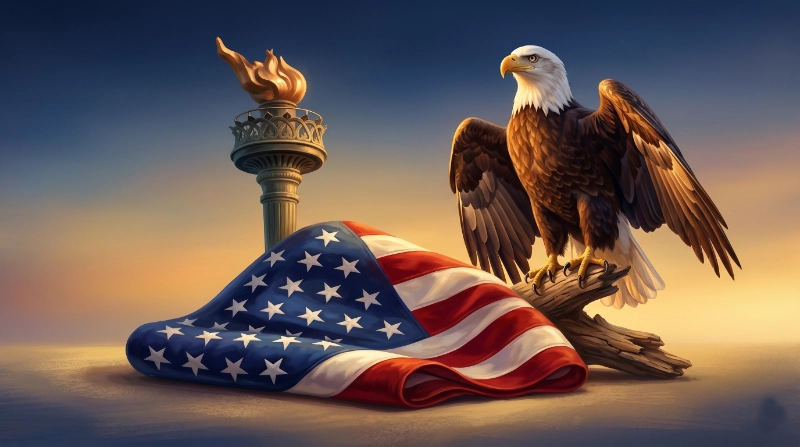
American symbols represent the country's identity and values. The most important are the U.S. flag (13 stripes for the original colonies, 50 stars for current states), the national anthem ("The Star-Spangled Banner"), and the bald eagle (national bird). These symbols appear in citizenship test questions.
Key American symbols:
- U.S. flag: 13 red and white stripes (original colonies), 50 white stars on blue (current states)
- National anthem: "The Star-Spangled Banner," written by Francis Scott Key in 1814
- National bird: Bald eagle
- National motto: "In God We Trust"
- Pledge of Allegiance: declaration of loyalty to the flag and the country
- Statue of Liberty: gift from France, located in New York Harbor
The American Flag
The U.S. flag is one of the most recognizable symbols in the world.
Design
- 50 stars — one for each of the 50 states
- 13 stripes (7 red, 6 white) — representing the 13 original colonies that declared independence in 1776
- Colors: red, white, and blue
History
The flag has changed many times as new states joined the Union. The original flag had 13 stars arranged in a circle. Today's 50-star flag was adopted on July 4, 1960, after Hawaii became the 50th state.
Flag Day
June 14 is Flag Day, commemorating the adoption of the flag by the Continental Congress in 1777. It is not a federal holiday but is widely observed.
The Pledge of Allegiance
Many Americans recite the Pledge of Allegiance — a promise of loyalty to the flag and the nation:
"I pledge allegiance to the flag of the United States of America, and to the republic for which it stands, one nation under God, indivisible, with liberty and justice for all."
The National Anthem
The national anthem of the United States is "The Star-Spangled Banner."
It was written by Francis Scott Key in 1814 after he watched the British bombardment of Fort McHenry in Baltimore, Maryland during the War of 1812. When dawn came, Key saw the American flag still flying over the fort — inspiration for the song.
Key facts:
- Written in 1814 during the War of 1812
- Became the official national anthem in 1931
- It is typically sung before major sporting events and public ceremonies
- The song describes the flag surviving a battle — symbolizing American resilience
The Statue of Liberty
The Statue of Liberty stands on Liberty Island in New York Harbor. It is one of America's most famous landmarks and a powerful symbol of freedom and welcome.
Key facts:
- A gift from France to the United States in 1886
- Her official name: "Liberty Enlightening the World"
- She holds a torch in her right hand (representing enlightenment) and a tablet in her left (inscribed with July 4, 1776)
- The famous inscription at the base: "Give me your tired, your poor, your huddled masses yearning to breathe free"
- For millions of immigrants arriving by ship, the Statue of Liberty was the first thing they saw — a symbol of hope and new beginnings
The Bald Eagle
The bald eagle is the national bird and national symbol of the United States. It was chosen in 1782 as part of the Great Seal of the United States because it represents:
- Strength — a powerful predator
- Freedom — soaring through open skies
- Independence — uniquely North American
You can see the bald eagle on the Great Seal, the Presidential Seal, and U.S. currency.
Other National Symbols
- The Great Seal — used on official documents, features the bald eagle holding an olive branch (peace) and arrows (defense)
- Uncle Sam — a figure representing the U.S. government, famously depicted in the "I Want You" military recruitment poster
- The Liberty Bell — located in Philadelphia, cracked but iconic, symbolizing American independence
- The White House — home of the President, symbol of the executive branch
Test Questions About Symbols
Q: Why does the flag have 50 stars? A: Because there are 50 states
Q: Why does the flag have 13 stripes? A: Because there were 13 original colonies
Q: What is the name of the national anthem? A: The Star-Spangled Banner
Q: Where is the Statue of Liberty? A: New York Harbor / Liberty Island (also acceptable: New Jersey / near New York City)
Frequently Asked Questions
Why does the U.S. flag have 13 stripes?
The 13 stripes on the U.S. flag represent the original 13 colonies that became the first 13 states. The stripes alternate red and white.
Why does the U.S. flag have 50 stars?
The 50 stars on the U.S. flag represent the 50 current states. A new star is added when a state joins the Union.
What is the name of the national anthem?
The U.S. national anthem is called "The Star-Spangled Banner." It was written by Francis Scott Key in 1814 during the War of 1812.
Who wrote "The Star-Spangled Banner"?
Francis Scott Key wrote "The Star-Spangled Banner" after witnessing the British bombardment of Fort McHenry in Baltimore Harbor on September 14, 1814. The song became the official national anthem in 1931.
What is the Pledge of Allegiance?
The Pledge of Allegiance is a declaration of loyalty to the U.S. flag and the republic it represents. It is recited at many public events, including in schools and at naturalization ceremonies.
Where is the Statue of Liberty?
The Statue of Liberty stands on Liberty Island in New York Harbor. It was a gift from France in 1886 and has welcomed millions of immigrants arriving in America.
Key Takeaways
- Flag: 50 stars (states) + 13 stripes (original colonies)
- National anthem: "The Star-Spangled Banner" — written by Francis Scott Key in 1814
- Statue of Liberty — gift from France, symbol of freedom, located in New York Harbor
- Bald eagle — national bird, symbol of strength and freedom
- These symbols represent core American values: freedom, democracy, resilience, and welcome